September 5, 2026
AI Is Watching Your Network — And That’s a Good Thing
Quick answers
- What is AI intrusion detection? It is cybersecurity technology that analyzes network, device, identity, email, and cloud activity to identify suspicious behavior.
- How does AI detect cyber threats? It learns what normal activity looks like, recognizes unusual patterns, connects related warning signs, and prioritizes real threats.
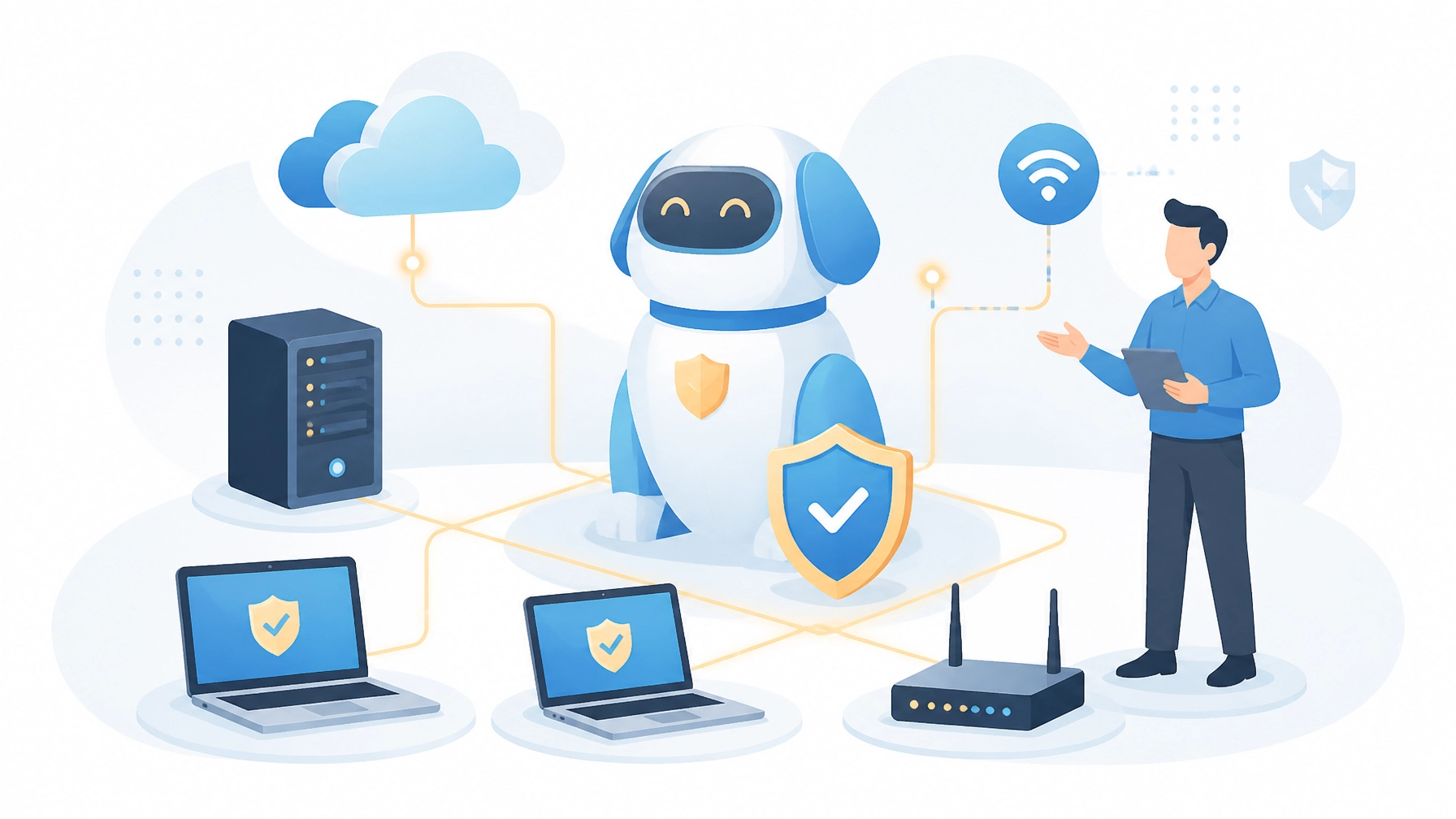
- Can AI replace human IT support? No. AI is a tireless watchdog. Experienced IT professionals provide judgment, context, strategy, and response.
- Why does it matter for small businesses? Attackers are using AI to move faster, personalize scams, and find weaknesses. SMBs need protection that can keep pace.
Artificial intelligence may sound intimidating. For many business owners, the phrase brings to mind systems making decisions without explanation or machines replacing the people they trust.
In cybersecurity, AI serves a much more practical purpose: it watches your technology continuously, identifies unusual activity quickly, and helps your IT team respond before a small problem becomes a costly breach.
That matters more than ever in 2026. Cybercriminals are using AI to accelerate reconnaissance, create convincing phishing messages, discover vulnerabilities, and automate parts of ransomware campaigns. IBM’s 2026 X-Force Threat Intelligence Index reported a 44% increase in attacks beginning with the exploitation of public-facing applications. CrowdStrike’s 2026 Global Threat Report reported an 89% increase in attacks by AI-enabled adversaries.
Your business deserves protection that is proactive, responsive, and built for the speed of modern attacks. AI-powered cybersecurity gives our team another set of eyes: one that never gets tired.
AI Cybersecurity for Small Business: Enterprise-Grade Protection Without the Enterprise Burden
Large enterprises have security operations centers staffed around the clock. Most small and midsize businesses do not: and that is completely understandable. Hiring, training, and retaining a full internal cybersecurity team can be expensive and difficult.
That does not mean your business should settle for basic antivirus and occasional updates.
AI cybersecurity for small business brings enterprise-grade analysis to organizations with leaner teams. It continuously reviews activity across your environment and helps identify risks that traditional tools or occasional human checks may miss.
With the right managed security partner, you gain access to:
- 24/7 monitoring of network and system activity
- Intrusion detection and prevention
- Endpoint detection and response
- Suspicious login and account activity analysis
- Phishing and malware protection
- Security event correlation and prioritization
- Human-led investigation and response
At Southwest Technical Support, our cybersecurity services combine layered protection with proactive monitoring. We do not wait for your team to discover a problem after systems stop working. We help identify warning signs earlier, investigate them, and keep your business moving.
AI Intrusion Detection: What It Actually Does
AI intrusion detection is not a mysterious black box deciding whether your business is safe. It is a system that processes large amounts of security information and looks for patterns that deserve attention.
Think of it as a highly attentive security guard for your digital environment.
A traditional security tool may recognize a known malicious file or a familiar attack signature. That remains valuable. However, attackers frequently change their methods, use legitimate tools, or exploit stolen credentials. A threat may not look obviously malicious when viewed as a single event.
AI helps by connecting the details.
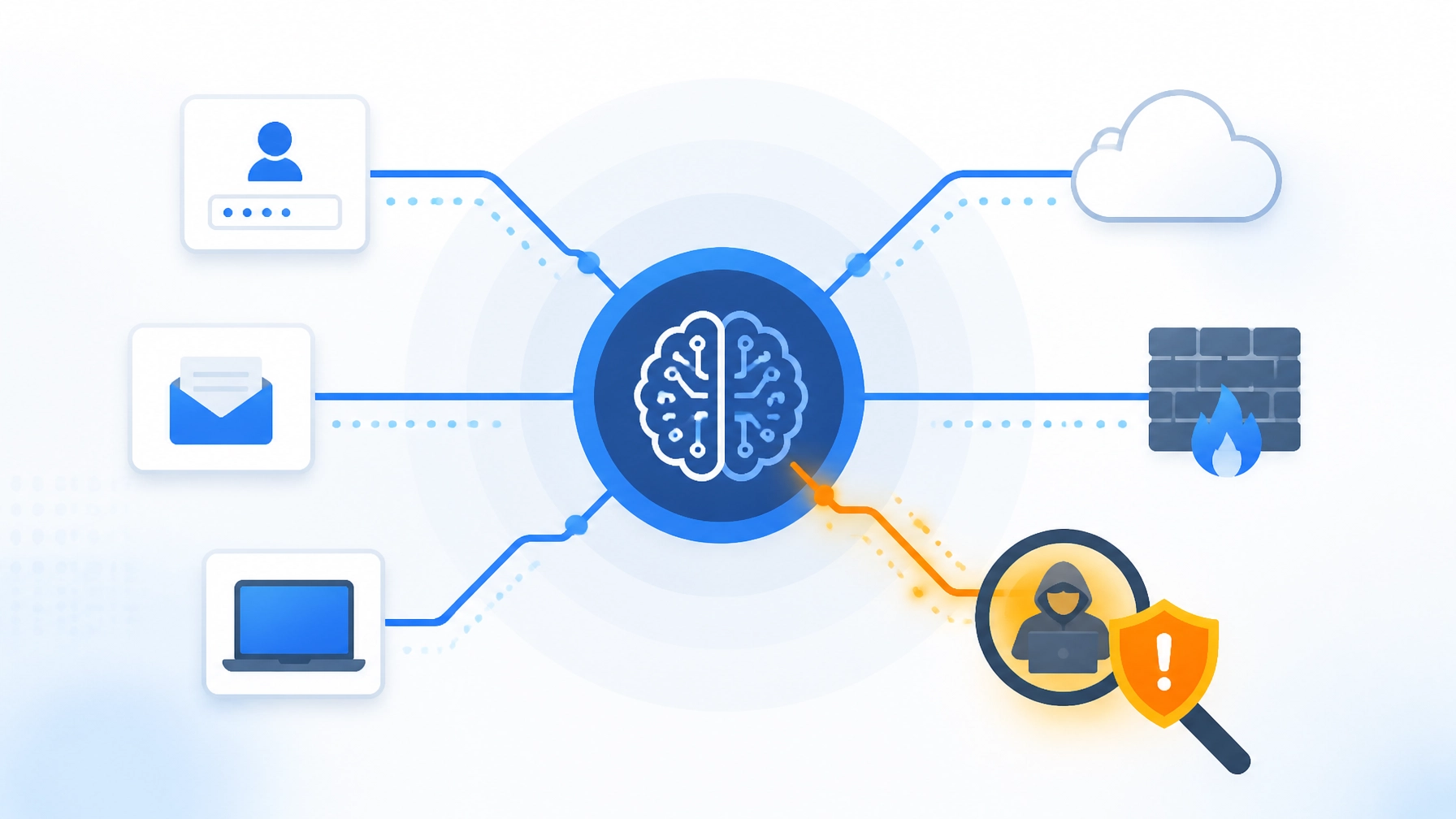
For example, one unusual login may be harmless. But if the login occurs at an unusual time, comes from an unfamiliar location, accesses an unusual file share, and is followed by a large data transfer, the combined pattern becomes much more concerning.
AI can correlate those events and bring them to our team as one potential incident rather than several disconnected alerts.
How AI Detects Cyber Threats: In Plain English
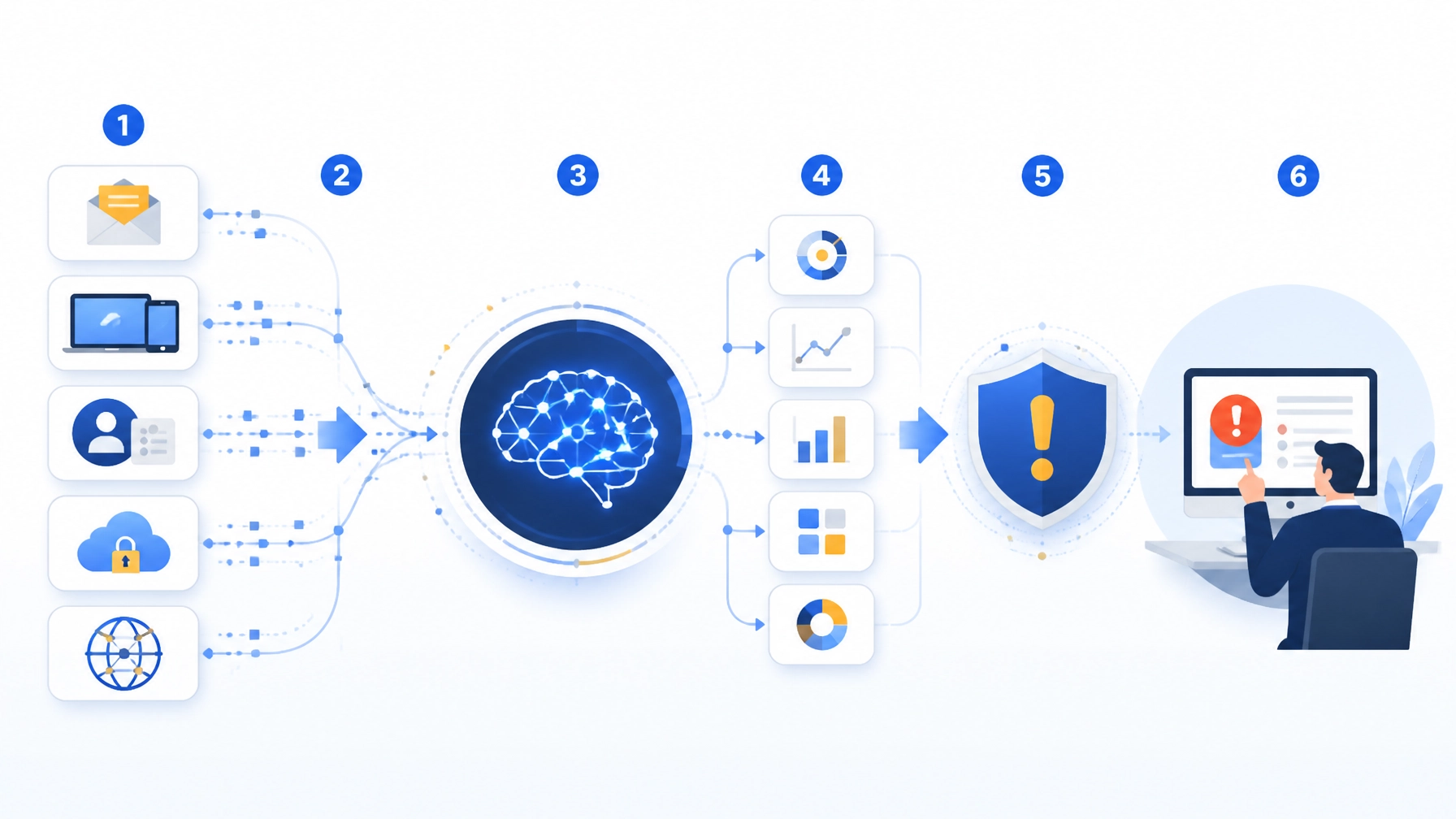
Understanding how AI detects cyber threats does not require a technical background. The process generally follows five straightforward steps.
1. It learns normal activity
AI-powered security tools establish behavioral baselines for users, devices, applications, and network traffic.
That means the system learns patterns such as:
- When employees typically sign in
- Which applications each device normally uses
- How much data your business usually transfers
- Which systems communicate with one another
- Where users generally connect from
Normal activity varies from business to business. A sudden transfer of several gigabytes may be normal for a design firm but unusual for a small accounting office. AI helps build a baseline specific to your organization.
2. It identifies unusual behavior
Once the system understands normal patterns, it can flag meaningful deviations.
Examples include:
- A user signing in from two distant locations within a short period
- A workstation communicating with an unfamiliar external server
- A normally quiet account accessing sensitive financial files
- A device launching an unusual script or process
- Multiple systems beginning to encrypt files rapidly
An anomaly does not automatically mean an attack is occurring. It means the event deserves review. Our IT professionals use context and investigation to determine what happens next.
3. It recognizes known and unknown threats
AI works alongside traditional security methods rather than replacing them.
Signature-based tools are effective at identifying known malware and established attack patterns. AI-based detection adds behavioral analysis, which can identify activity that looks suspicious even when the exact threat has never been seen before.
This is especially important against:
- Zero-day vulnerabilities
- Fileless malware
- Stolen credentials
- Business email compromise
- Insider threats
- New ransomware variants
- AI-generated phishing campaigns
4. It connects separate warning signs
Attackers rarely complete an intrusion in one step. They may begin with phishing, steal credentials, move laterally through the network, and then access or encrypt data.
AI threat detection connects related signals across email, endpoints, identities, cloud services, and network traffic. This helps create a clearer attack story and reduces the chance that small alerts disappear in a crowded dashboard.
5. It prioritizes what matters most
Security tools can generate a large number of alerts. Without proper prioritization, an overworked team may spend time investigating harmless events while a serious threat develops elsewhere.
AI helps rank alerts based on risk, context, affected systems, user privileges, and attack behavior. Our team can focus attention where it provides the greatest protection.
AI Threat Detection Helps People Catch What Humans Miss
People are essential to cybersecurity: but people have limits.
Even experienced IT professionals cannot manually review every login, connection, process, email, and file movement across a busy business network. Human attention declines over time, and attackers do not follow a convenient nine-to-five schedule.
AI excels at repetitive, high-volume observation. It can review activity continuously and compare millions of signals much faster than a person could.
That gives your IT team a significant advantage:
- More visibility: AI watches activity across multiple systems.
- Faster detection: Suspicious behavior can be identified in near real time.
- Less alert fatigue: Related events can be grouped and prioritized.
- Earlier containment: Devices or accounts may be isolated before an attack spreads.
- Better decisions: IT professionals receive context instead of disconnected alerts.
AI does not replace expertise. It helps your experts spend less time searching through noise and more time solving real problems.
Why AI Matters for SMBs in 2026
Small businesses are not invisible to cybercriminals. In many cases, attackers target them because they expect fewer security controls, limited internal staffing, and slower response times.
AI is changing the threat landscape in several important ways:
- Attackers can scan for exposed systems faster.
- Phishing messages can be highly personalized.
- Stolen credentials can be tested across multiple services automatically.
- Malware can be modified to avoid familiar detection methods.
- Ransomware groups can automate portions of their attack process.
CrowdStrike reported that the fastest recorded eCrime breakout time had fallen to 27 seconds in its 2026 report. The exact circumstances vary by incident, but the lesson is clear: businesses have less time to detect and contain threats.
Your defense must be proactive. Waiting for an employee to notice a suspicious file or for a server to stop responding is no longer enough.
Can AI Stop Ransomware?
AI cannot guarantee that every ransomware attack will be stopped. No responsible security provider should make that promise.
However, AI can improve the chances of stopping ransomware earlier by detecting the behaviors that often appear before widespread encryption. These may include:
- Unusual privilege escalation
- Credential theft
- Lateral movement between devices
- Suspicious administrative tools
- Large-scale file access
- Rapid file modification or encryption
- Unusual data staging before exfiltration
A modern security program combines AI detection with endpoint protection, patch management, multifactor authentication, network segmentation, employee training, and reliable backups.
That layered approach matters. If one control misses something, another can still limit the damage. Our backup and disaster recovery services provide an additional layer of protection when recovery is necessary.
AI Is the Watchdog. Human IT Professionals Are the Partners.
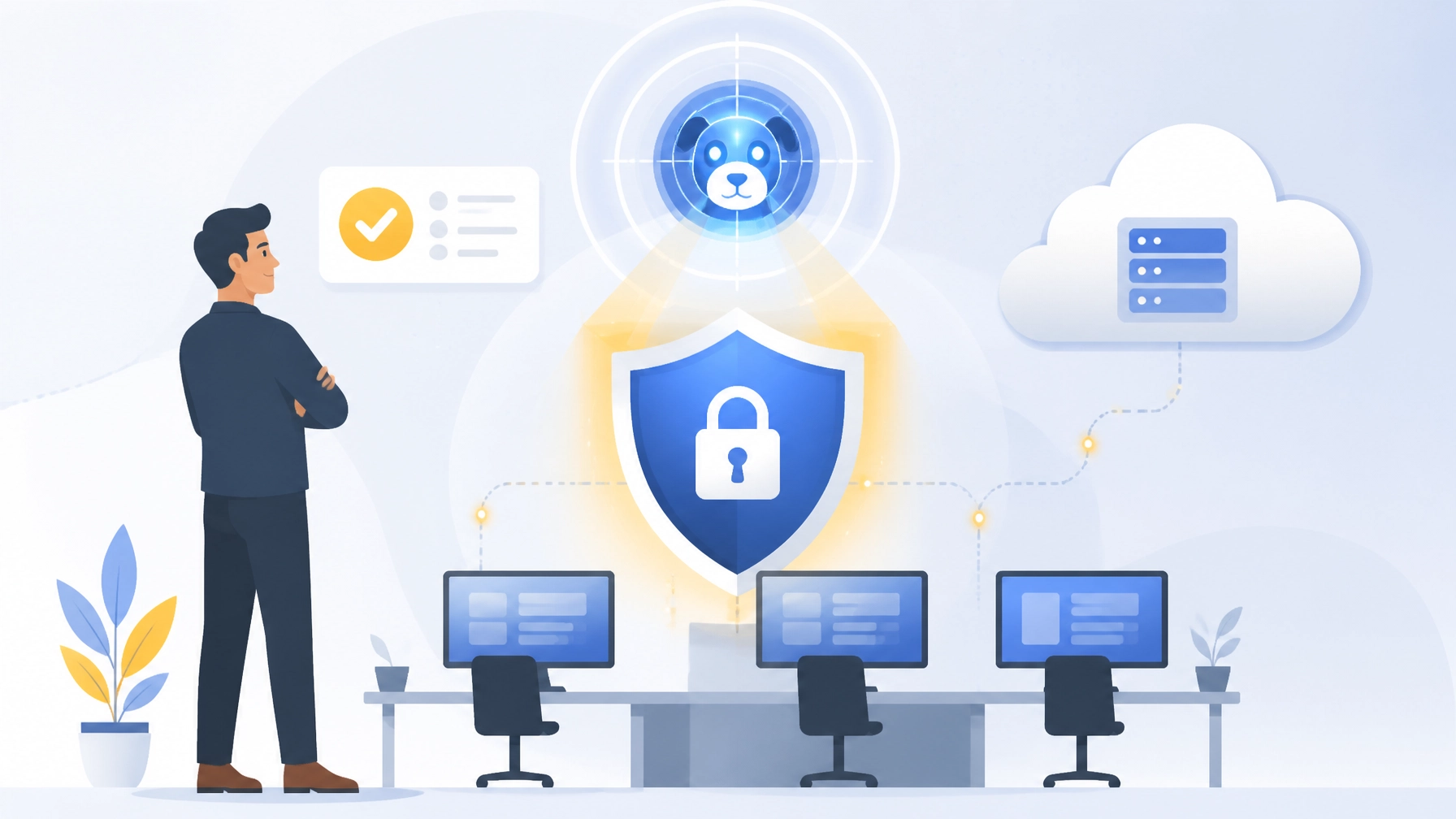
The most effective cybersecurity model is not humans versus AI. It is humans working with AI.
AI can notice patterns, process data, and raise an alert at machine speed. It cannot fully understand your business priorities, evaluate every operational consequence, or build a long-term technology plan.
Our professionals provide the human side of protection:
- We interpret alerts in your business context.
- We confirm whether activity is malicious or legitimate.
- We tune systems to reduce unnecessary notifications.
- We coordinate containment and recovery.
- We explain what happened in clear language.
- We recommend practical improvements for the future.
This partnership gives you technology that watches continuously and people who remain accountable for your security.
Is AI Cybersecurity Expensive for Small Business?
AI cybersecurity does not have to mean purchasing and managing a complex enterprise platform on your own.
Managed IT services make advanced protection more accessible by combining the technology, monitoring, configuration, and expertise your business needs into a scalable service plan. The right approach depends on your number of users and devices, industry requirements, existing security controls, and risk profile.
The more useful question is not simply, “What does AI cybersecurity cost?” It is, “What would an avoidable breach cost our business in downtime, lost data, recovery, reputation, and customer trust?”
We can help you evaluate those risks and identify practical next steps without overcomplicating your environment.
Work With a Partner Who Watches Over Your Business
Your business needs security that keeps pace with modern threats without making technology harder to manage.
Southwest Technical Support delivers proactive IT support, cybersecurity, intrusion detection, 24/7 monitoring, backup solutions, and responsive human guidance for small and midsize businesses across the Dallas–Fort Worth area.
AI gives our team broader visibility and faster analysis. Our people provide the experience, judgment, and partnership behind every decision.
Contact Southwest Technical Support to discuss how AI-powered intrusion detection can help keep your business secure, productive, and ahead of the curve.
Frequently Asked Questions
How is AI used in cybersecurity?
AI is used to analyze network traffic, device activity, login behavior, email patterns, cloud events, and security logs. It learns normal behavior, identifies anomalies, correlates related events, prioritizes risk, and can assist with automated containment. Human IT professionals review important findings and guide the response.
Can AI stop ransomware?
AI can detect ransomware-related behavior, such as unusual privilege use, lateral movement, rapid file changes, and mass encryption patterns. It can help security teams respond earlier, but it cannot guarantee that every attack will be stopped. Effective ransomware protection also requires backups, patching, endpoint security, multifactor authentication, and employee awareness.
Is AI cybersecurity expensive for small business?
AI cybersecurity is available through managed service plans designed for small and midsize businesses. Pricing depends on factors such as the number of users, devices, systems, and required security controls. A managed provider helps make enterprise-grade monitoring and detection accessible without requiring your business to build a full internal security operations center.
Does AI replace human IT support?
No. AI handles continuous monitoring, pattern recognition, and high-volume analysis. Human IT professionals investigate alerts, apply business context, make decisions, communicate with stakeholders, and plan improvements. AI is a powerful watchdog, while experienced IT partners remain responsible for strategy and support.
Have an IT challenge to solve?
Our DFW team is ready to help. Get a free, no-pressure assessment.
Get in touch